
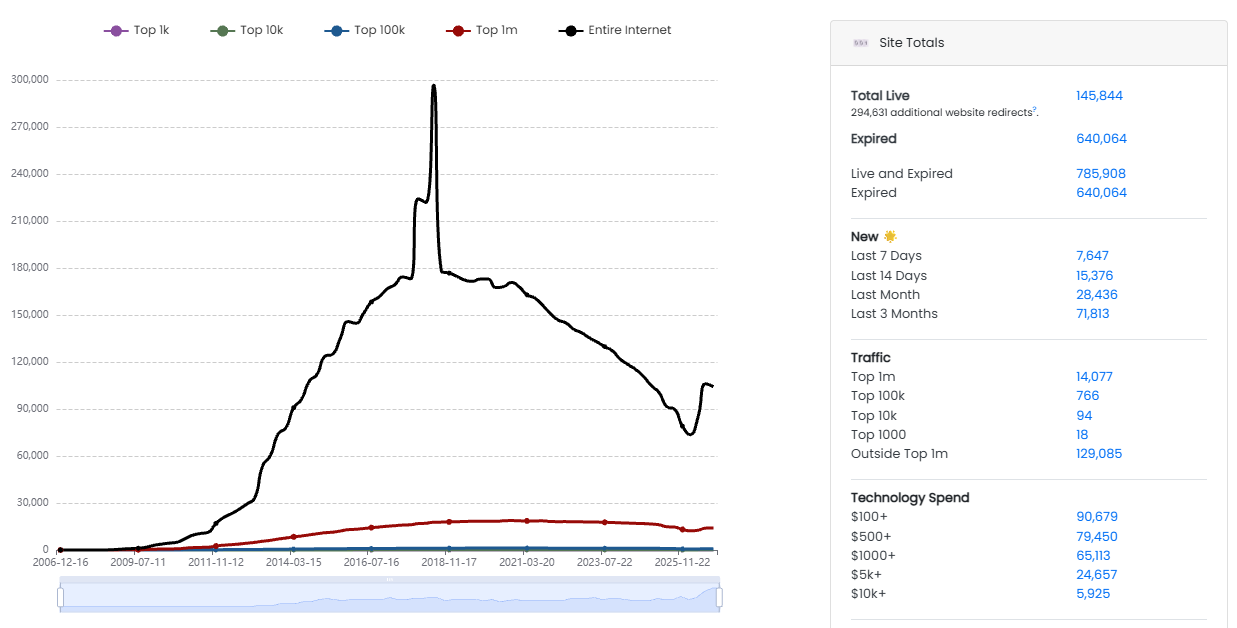
We wanted to answer a simple question:
What does the Magento market look like today?
So we bought the All Live Magento Sites dataset from BuiltWith.
The file contained 151,428 unique root domains. At first, the conclusion seemed obvious: Magento still had a very large market.
But the more closely we looked at the data, the more interesting the story became.
The Magento market is large. It is also highly uneven. Most detected sites are part of a long tail of smaller or poorly documented websites. A much smaller group of serious merchants appears to create most of the commercial value.
That distinction matters if you sell Magento development, hosting, extensions, integrations, or consulting.
151,428 websites do not mean 151,428 Magento customers
The dataset contains 151,428 unique root domains, but not every row represents a separate, active Magento merchant.
We found:
- 142,976 domains with Magento listed directly as an ecommerce technology.
- 118,990 domains, or 78.6%, where Magento was the only detected ecommerce platform.
- 24,160 domains, or 16.0%, with more than one ecommerce platform detected.
- 7,356 domains, or 4.9%, with no value in the Ecommerce Platform field.
For example, more than 5,000 domains had both Magento and Shopify signals.
There are several possible reasons. A company may be moving from one platform to another. It may use different platforms on different subdomains. Old scripts may still be visible. Some detections may also be false positives.
One company can operate several stores and domains. A domain can also remain online even when it is no longer a working store.
For that reason, we treat 151,428 as a count of domains in the detected Magento footprint. We do not treat it as a count of paying Adobe customers, independent merchants, or active Magento installations.
BuiltWith's public Magento report currently shows a similar total of roughly 145,000 live Magento customers. This gives us confidence that the dataset is useful for studying the structure of the market, as long as we use the right definition.
Magento has a very large long tail
The distribution of estimated technology spending was one of the clearest findings.
| Estimated monthly technology spend | Domains | Share of dataset |
|---|---|---|
| $0 | 37,285 | 24.6% |
| Below $1,000 | 47,117 | 31.1% |
| $1,000–$4,999 | 41,301 | 27.3% |
| $5,000–$9,999 | 19,600 | 12.9% |
| $10,000 or more | 6,124 | 4.0% |
The median estimated spend was only $830 per month.
BuiltWith defines Technology Spend as the estimated monthly cost of the web technologies found across a website. It is not the Magento license fee, and it is not the merchant's total technology budget.
Even with that limitation, the distribution tells us something useful.
Magento has a wide installed base, but the commercial value of the ecosystem is probably concentrated in a much smaller group of merchants.
The long tail may include small stores, old websites, secondary storefronts, low-traffic projects, test environments, and domains for which little business information is available.
Above that long tail is a smaller group of merchants with higher traffic, larger catalogs, and more complex technology stacks. These companies are more likely to buy development, maintenance, hosting, extensions, and integration services.
A small economic core may create most of the value
Only 15,260 domains, or 10.1% of the dataset, had a Tranco traffic rank.
Within the full dataset:
- 779 domains were in the Tranco top 100,000.
- 97 domains were in the top 10,000.
- 6,708 domains had employee data.
- 30,976 domains had product catalog data.
Among the sites with catalog data, the median was 598 SKUs. One quarter had at least 2,854 SKUs, and the top 10% had more than 10,000.
This helps explain why Magento remains relevant even when easier platforms are available.
Magento does not need to have the largest number of stores to support a valuable ecosystem. Its strongest position is among merchants with large catalogs, complex pricing, several markets, many integrations, or unusual operating requirements.
These merchants are also harder to move.
A simple store can change platforms relatively quickly. A store connected to an ERP, warehouse system, product information system, search service, loyalty program, and several local payment methods faces a much larger migration project.
Magento's installed base may not be growing quickly, but part of that base is deeply embedded in the merchant's operations.
The United States and Western Europe are the main centers
BuiltWith identified a country for 68,515 domains. The other 82,913 domains, or 54.8% of the dataset, had no country information.
Among the domains with a known country, the largest markets were:
| Country | Domains | Share of domains with known country |
|---|---|---|
| United States | 18,783 | 27.4% |
| United Kingdom | 6,808 | 9.9% |
| Netherlands | 5,698 | 8.3% |
| Germany | 4,828 | 7.0% |
| Spain | 3,072 | 4.5% |
| Italy | 2,606 | 3.8% |
| France | 2,380 | 3.5% |
| Australia | 2,158 | 3.1% |
The United States is the largest single market. Western Europe also has a strong Magento presence.
The Netherlands stands out. Despite its smaller population, it had almost 5,700 detected Magento domains. This suggests a deep local network of merchants, agencies, developers, and hosting providers.
Magento is useful for many problems common in European commerce: several languages, different tax rules, local payment methods, multiple store views, and cross-border selling.
It may therefore be more useful to think of Magento as a group of regional markets rather than one uniform global market.
The Magento economy is larger than the platform itself
The technologies used alongside Magento show the size of the surrounding ecosystem.
Common payment signals included:
- PayPal on more than 60,000 domains.
- Braintree on about 39,000.
- Google Pay on almost 15,000.
- Stripe on more than 12,000.
- Apple Pay and Klarna on about 7,000 each.
- Adyen on more than 2,000.
Klaviyo appeared on almost 31,000 domains. Adobe Marketing Cloud and Insider also had a large presence.
On the infrastructure side, Cloudflare appeared on more than 72,000 domains. Amazon, Google Cloud, Hetzner, Fastly, Hypernode, and Cloudways each appeared on thousands of sites.
This changes how we should define the Magento market.
The market includes much more than Adobe Commerce licenses or Magento Open Source downloads. It includes:
- Store design and development.
- Hosting and cloud infrastructure.
- Performance work.
- Security and maintenance.
- Payment integrations.
- Search and product discovery.
- CRM and marketing automation.
- ERP, PIM, and warehouse integrations.
- Extension development.
- Platform migration and modernization.
For many companies in the ecosystem, the best opportunity may not be a merchant launching a new Magento store. It may be an existing merchant that needs to make a complex system faster, safer, and easier to operate.
Magento is becoming several related markets
The dataset does not describe one single Magento product.
It includes:
- 1,724 domains with a Magento Enterprise signal.
- 1,282 with an Adobe Commerce B2B signal.
- 1,493 with OpenMage.
- 5,124 with Hyvä Themes.
- A smaller group with Mage-OS.
A note on the Adobe Commerce count: BuiltWith’s “Magento Commerce” figure is a technology-detection count, not a complete count of Adobe Commerce customers. Some PaaS, SaaS, self-hosted, and hardened deployments may not expose the public signals needed for accurate classification. The dataset should not be used to estimate the full Adobe Commerce installed base.
These groups can overlap, but they show that the ecosystem is moving in several directions.
At one end is Adobe Commerce, aimed at larger organizations, B2B commerce, personalization, and complex operations.
At the other end is Magento Open Source, together with community projects such as OpenMage and Mage-OS.
Between them is a growing modernization market. Hyvä is the clearest signal in this dataset. It appeared on more than 5,000 domains, or about 3.4% of the complete list.
That does not make Hyvä the default Magento frontend. It does show that a meaningful group of merchants is still investing in the platform.
This is important because a large installed base can simply be old software that has not yet been replaced. Spending money on a new frontend, better performance, or new integrations is stronger evidence of continued commitment.
The data also tells us what we do not know
More than 79,000 domains in the file had a First Detected date in 2026.
Taken literally, this would suggest a huge wave of new Magento stores. That is almost certainly the wrong conclusion.
First Detected means the first time BuiltWith found the technology. It can reflect new crawling activity or improved coverage. It is not necessarily the date on which the store launched.
The dataset has other limits:
- 54.8% of domains had no country.
- 53.9% had no industry classification.
- Only 4.4% had employee data.
- Estimated sales revenue was available for about 43.5% of domains.
- Some revenue values were technical limits rather than credible business estimates.
- Many domains showed signals from more than one ecommerce platform.
The dataset is useful for understanding the shape of the Magento market. It is not enough to tell us the direction of the market.
It gives us a photograph, not a movie.
What does the Magento market look like today?
The data does not support the simple story that Magento is disappearing.
With roughly 145,000 to 150,000 detected live domains, Magento still has a large global footprint. It is particularly strong in the United States and Western Europe. It also supports a substantial economy around development, hosting, payments, marketing, and integrations.
But the health of the market cannot be measured by website count alone.
Most of the installed base belongs to a long tail. The economic value is probably concentrated among a much smaller group of merchants with strong traffic, larger catalogs, higher technology spending, and more complex operations.
The most useful question is therefore no longer:
How many websites use Magento?
It is:
How many valuable merchants are still investing in Magento, what are they investing in, and are they staying or leaving?
To answer that question, we need to follow the market over time:
- Which Magento sites are new?
- Which sites leave Magento?
- Where do they go?
- How many are moving from Magento 1 to Magento 2?
- How many are adopting Hyvä or other modern storefronts?
- Is the high-traffic, high-spend part of the market growing, stable, or shrinking?
The BuiltWith dataset gives us a strong starting point.
What it shows today is a mature and highly segmented market. Magento's value is no longer mainly about adding as many websites as possible. It is about the complexity of the merchants that remain, the amount they continue to invest, and the ecosystem required to support them.
Data and methodology
This analysis uses the All Live Magento Sites — 2026-08-24 dataset purchased from BuiltWith. The original file contained 151,428 unique root domains.
Technology Spend and Sales Revenue are BuiltWith estimates. Technology Spend represents estimated monthly spending on detected web technologies across a site. Sales Revenue represents estimated monthly ecommerce revenue. Neither measure should be treated as audited company data.
Country percentages were calculated only from domains with a known country. Technology counts can overlap because one domain can use several services from the same category.